
Industrial Market Momentum Is Building: What Every Inland Empire Industrial Property Owner Should Know in 2026

Industrial Market Momentum Is Building: What Every Inland Empire Industrial Property Owner Should Know in 2026. If you've been keeping an eye on the industrial real estate market over the past couple of years, you've probably noticed things have felt... different.
Construction slowed. Leasing activity softened. Developers became more cautious. Many property owners wondered if the incredible momentum the market experienced during the pandemic was simply gone for good.
Well, here's the good news—it isn't.
In fact, we're seeing a noticeable shift. The industrial real estate market is building momentum once again, but this time, it's happening for all the right reasons.
Instead of speculative construction and rapid expansion, today's market is being fueled by genuine tenant demand, smarter development decisions, and long-term confidence in the industrial sector. That's creating exciting opportunities for industrial property owners, developers, investors, and owner-users alike.
At Bobby Mendez Realty, we spend every day talking with buyers, sellers, developers, and investors throughout Southern California. The conversations we're having today are much different than they were even a year ago—and that's a positive sign.
Let's take a closer look at what's driving today's industrial market.
Big-Box Warehouse Leasing Is Making a Comeback
One of the biggest indicators of a healthy industrial market is leasing activity.
Fortunately, leasing demand has returned in a big way.
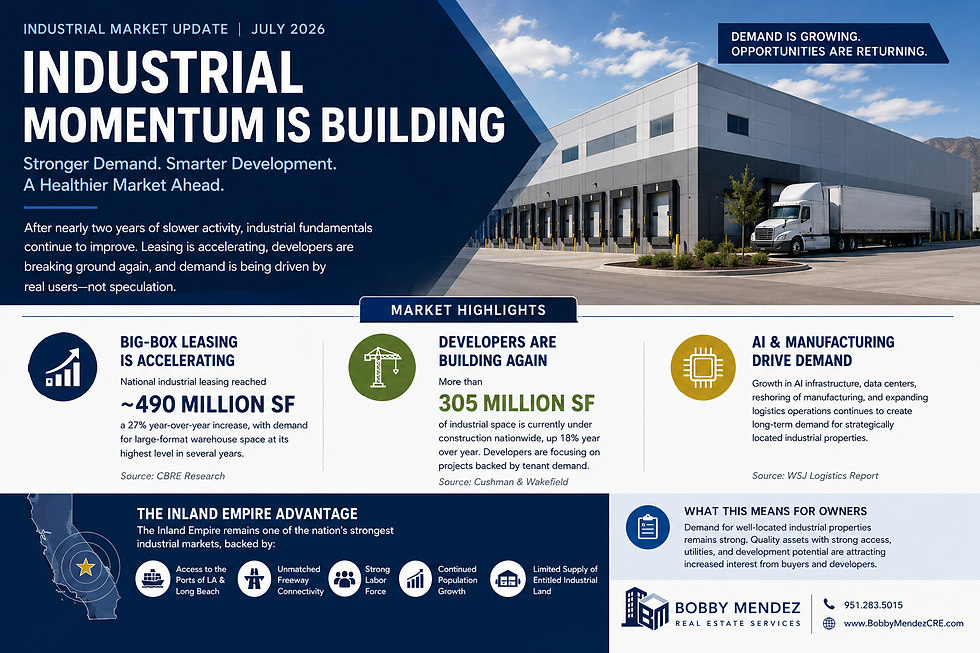
Large warehouse users are actively searching for space again, helping absorb excess inventory that accumulated over the past two years. National industrial leasing recently climbed to nearly 490 million square feet, representing one of the strongest leasing years we've seen since 2022.
Why does this matter? Because leasing activity typically leads future development.
When companies commit to large warehouse spaces, developers gain confidence to begin new projects. Likewise, investors become more comfortable deploying capital into industrial assets.
Simply put, strong leasing creates momentum throughout the entire market.
Developers Are Building Again—But They're Doing It Smarter
During the pandemic, it sometimes felt like industrial buildings were going up everywhere.
Developers were racing to meet unprecedented demand, and speculative construction became common.
Today's market looks much different. Instead of building first and hoping tenants arrive later, developers are increasingly focusing on projects supported by actual demand. That shift creates healthier market conditions for everyone involved. Currently, more than 305 million square feet of industrial space is under construction across the United States—an impressive increase over last year. Even better, much of that development is being backed by committed users instead of speculation. That's exactly the type of market that tends to create sustainable long-term growth.
AI Is Changing More Than Technology
When most people hear "Artificial Intelligence," they immediately think about software, robots, or ChatGPT. But AI is also having a tremendous impact on warehouse development.
Every new data center requires massive amounts of equipment, servers, electrical infrastructure, cooling systems, and logistics support. Those materials have to be manufactured, transported, stored, and distributed somewhere. That "somewhere" is often industrial real estate. Meanwhile, manufacturers continue reshoring operations back to the United States, retailers are building stronger inventory strategies, and third-party logistics companies continue expanding their distribution networks. Together, these trends continue creating demand for high-quality industrial property across the country.
Why the Inland Empire Continues to Stand Out
Although industrial demand is improving nationwide, few markets are positioned as well as Southern California's Inland Empire. There are several reasons why developers continue targeting this region.
First, the Inland Empire offers unmatched access to the Ports of Los Angeles and Long Beach, two of the busiest ports in North America. Second, the area's freeway network provides outstanding connectivity throughout California and the western United States.
Additionally, businesses benefit from an experienced labor force, growing population, and established logistics infrastructure. Perhaps most importantly, entitled industrial land continues becoming harder to find. As available sites become increasingly limited, well-located industrial properties often become more valuable over time. That's one reason institutional investors continue focusing on the Inland Empire despite broader economic uncertainty.
What This Means for Industrial Property Owners
If you own industrial real estate, today's market is worth paying attention to. Buyer activity has steadily improved. Developers are actively evaluating new opportunities.
Investors continue searching for quality assets. Owner-users are expanding again.
Of course, every property is different. Location, zoning, utilities, building condition, access, and entitlement status all play an important role in determining value.
However, owners of quality industrial land and well-positioned industrial facilities may find today's market offers more opportunities than it did just a year ago.
If you've been considering selling—or even if you're simply curious about your property's current value—now is an excellent time to begin that conversation.
The Market Is Healthier Than Headlines Suggest
It's easy to get distracted by national economic headlines. Interest rates, inflation, tariffs, and political uncertainty all receive plenty of attention. Yet when we look specifically at industrial real estate fundamentals, the story becomes much more encouraging. Leasing activity continues improving. Vacancy rates are stabilizing. Developers remain active. Construction is increasing—but in a disciplined way.
That's exactly the type of balanced market that creates long-term stability instead of short-lived booms.
Instead of chasing rapid growth, today's industrial market appears to be building a stronger foundation for years ahead.
Why Local Expertise Matters More Than Ever
Industrial real estate isn't a one-size-fits-all business. Every market has its own trends. Every city has different zoning regulations. Every property has unique opportunities.
That's why working with professionals who understand the local market can make a tremendous difference. At Bobby Mendez Realty, we specialize in helping owners, developers, investors, and businesses navigate the ever-changing Inland Empire industrial market. Whether you're exploring a sale, searching for investment opportunities, or simply looking for reliable market information, our goal is always the same—to provide honest guidance backed by local expertise and real market experience.
Looking Ahead
All signs point toward continued improvement throughout 2026. Industrial demand remains healthy.
Developers are building with greater discipline. Investors continue targeting quality assets.
Meanwhile, Southern California remains one of the country's premier logistics hubs.
While no market moves in a perfectly straight line, today's fundamentals suggest the industrial sector is entering a more sustainable phase of growth than we've seen in recent years.
For industrial property owners, that's an encouraging trend worth watching.
Ready to Talk About Your Property?
Whether you're thinking about selling, investing, or simply want a confidential opinion of value, Bobby Mendez Realty is here to help. Our team specializes in commercial real estate, industrial real estate, land, and investment properties throughout the Inland Empire and Southern California.
If you'd like to discuss your property's current market value or learn more about what's happening in today's market, we'd love to connect.
📞 951.283.5015🌐 www.BobbyMendezCRE.com


Comments